The benefits of energy storage are well known; not only do batteries help smooth the intermittency of solar power but they can also help improve the economics of certain solar installations.
In the UK, the mechanics of solar are simple –
Step 1
Generate the power
Step 2
Consume the power
(offsetting grid costs at anything from 20p – 50p per unit)
Step 3
Export the power
(at anything from 4p – 16p)
With energy storage, not only can you take your site ‘off-grid’ but you can also avoid selling your power at a ‘loss’. Additionally, an appropriately sized battery can help support your operations if you experience a power cut.
Unfortunately, ascertaining the economic benefit of a battery is not straightforward; there are dozens of variables to assess in order to determine the optimum behaviour of the storage asset.
Be
Smarter
With BeBa Energy’s ‘Be Smarter’ programme, not only can we help you better understand your electricity usage, we can also help you determine whether or not your site is appropriate for batteries without the need for dozens of sweeping assumptions
By monitoring the generation profile of your existing solar asset, the level of export, and the balance of power bought from the grid, over the course of 12 months we can produce accurate modelling to support your decision making when it comes to investing in batteries.
What information does it display?
The Be Smarter monitoring system displays information in these three ways.
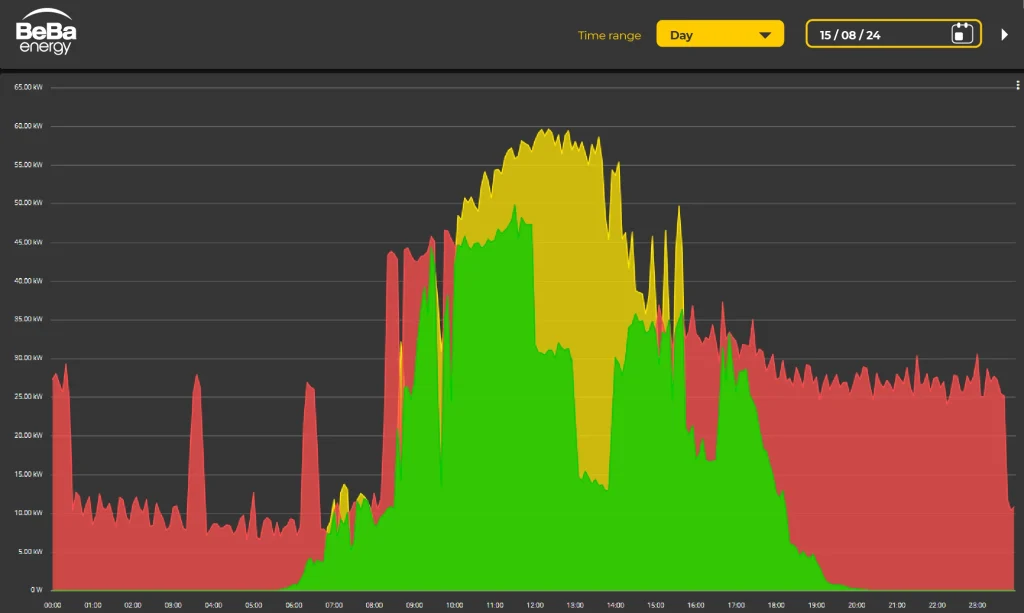
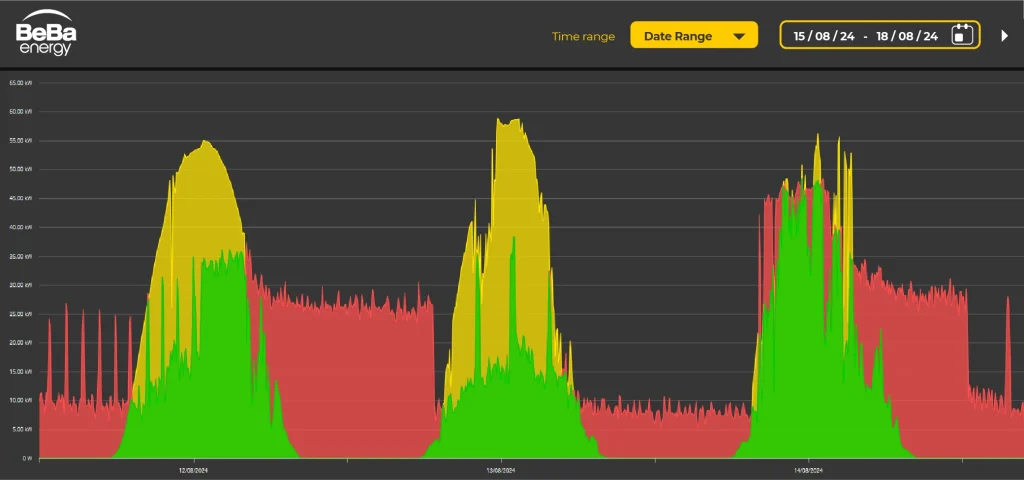
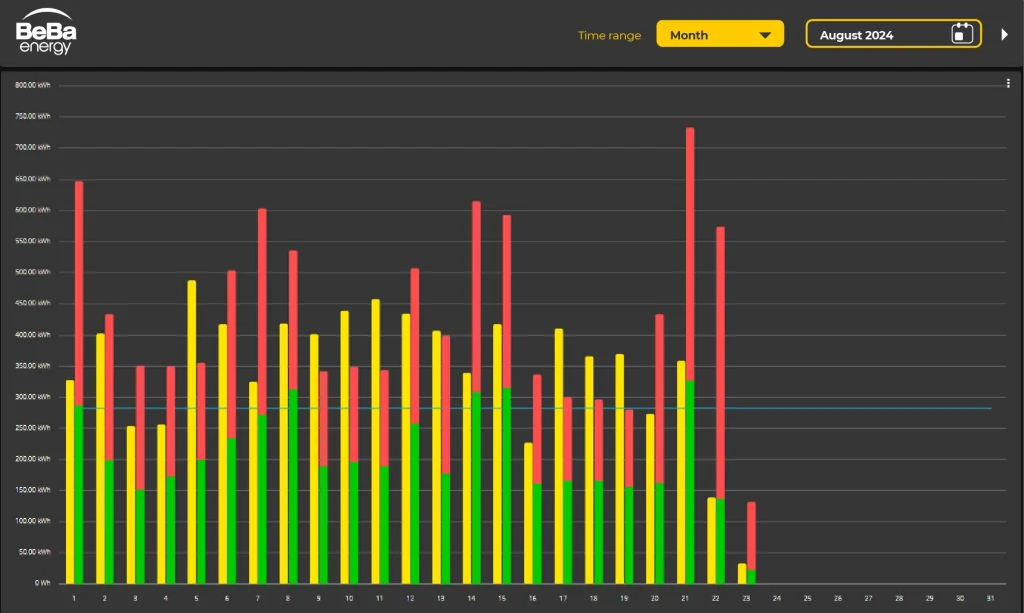
Red indicates the demand from the grid
Yellow indicates the production of solar power from the array
Green indicates the amount of solar power your site consumes
This view shows the activity of a solar array over a 24hr period.
This view shows the activity of a solar array across a selected date range.
This view shows the activity of a solar array across a month.
How do we use this information?
Once we have a data set over an agreed period of time (ideally 12 months), we will get to work on analysing the current balance of power. There are many calculations needed to determine the correct battery size, starting with a study of the data to work out how much power is being produced by the solar along with how much of that is being used directly onsite. Thereafter, our engineers will assess the following:
The loads over specific times of the day
The level of export throughout the day
The required charge and discharge rate in to and out of the batteries dependant on load factors
Once the modelling has been completed, a BeBa engineer will be able to determine what size and type of battery solution would work best for your business.
Call BeBa today to begin your ‘Be Smarter’ journey.
What is solar battery storage?
Battery storage involves storing solar power generated by the array and releasing it when needed or when it is most economically advantageous.
Can I add a battery to my existing solar array?
Yes – any AC coupled battery can be used on an existing solar pv array.
What is the difference between AC-coupled and DC-coupled battery systems?
The difference lies in how each system connects to the owner’s electricity setup. DC-coupled batteries are more efficient because they store DC electricity directly from the solar panels, with conversion to AC happening only when the energy is used. In contrast, AC-coupled systems are ideal for adding batteries to existing setups, but they involve multiple conversions (DC to AC to DC to AC), which leads to energy loss with each conversion.
What are the benefits of adding battery storage to my solar array?
There are many benefits from adding a battery to your solar array such as:
Less export, more onsite consumption
Time of use charging
Back up capabilities in the event of a power cut (dependent on site loads)